


Blackjack Hit or Stand Guide for Better Decisions
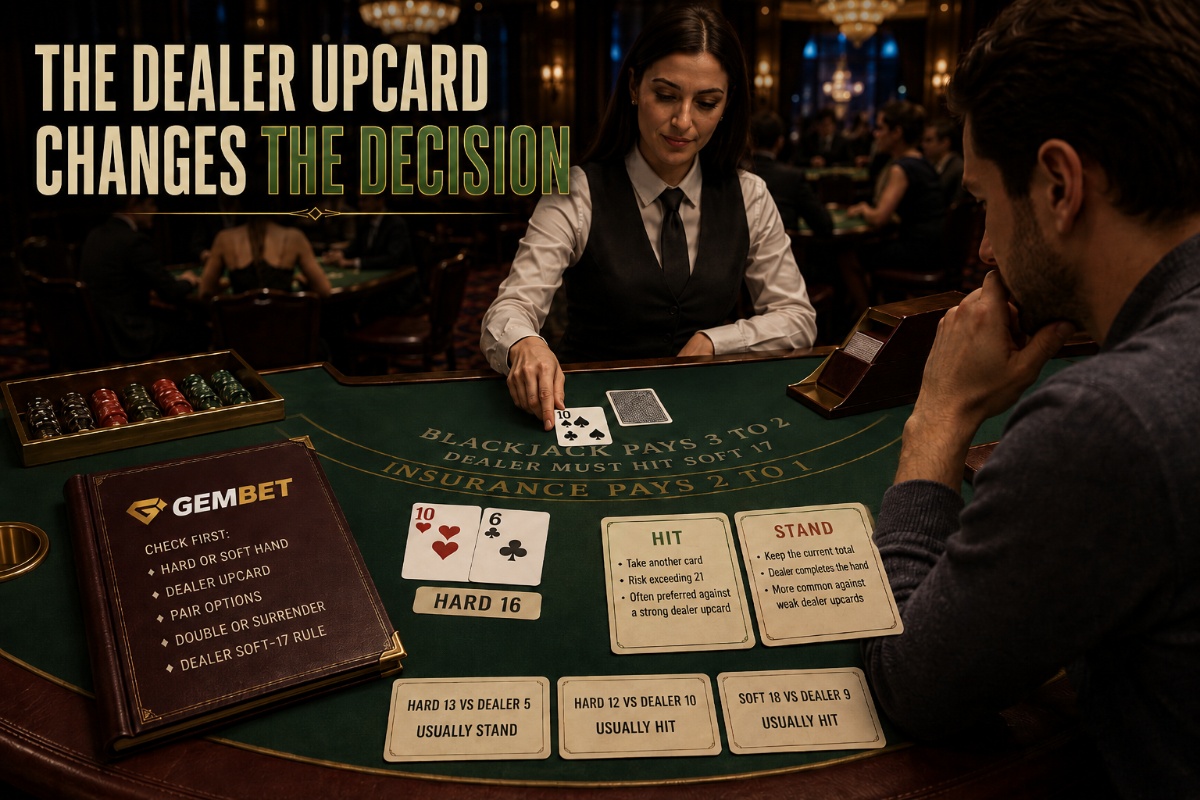
A blackjack hit or stand guide should begin with one fact: the player is deciding whether to accept another card or keep the current total. The correct choice depends on whether the hand is hard or soft, the dealer’s visible card, and the table rules.
Blackjack hit or stand decisions at a glance
| Hand | Typical direction |
|---|---|
| Hard 17+ | Stand |
| Hard 13–16 vs 2–6 | Usually stand |
| Hard 12 vs 4–6 | Usually stand |
| Soft 17 or less | Hit or double |
| Soft 19+ | Stand |
Hit and stand describe two different risk choices
In this blackjack hit or stand guide, hitting means asking for another card. Standing ends the player’s decisions and keeps the current total for comparison with the dealer. If a hit takes the total above 21, the hand busts immediately and loses before the dealer completes the round.
Card values are simple: 2 through 9 count at face value, tens and picture cards count as 10, and an Ace can count as 1 or 11. Singapore’s approved blackjack rules define the same values and allow players to draw additional cards or stand before the dealer completes the hand.
Blackjack hit or stand guide for hard hands
A hard hand contains no Ace counted as 11. Ten plus 6 is hard 16. Ace, 5, and 10 is also hard 16 because the Ace must count as 1 to avoid busting.
The most difficult blackjack hit or stand decisions often involve hard 12 through 16. These totals can bust with another card, yet they may still be too low to beat a dealer showing 7, 8, 9, 10, or Ace.
This is why “never hit 16” is poor advice. Standing on hard 16 against a dealer 10 leaves the player relying on the dealer to finish with a lower total or bust. Basic strategy generally prefers hitting unless surrender is available and recommended for the exact rules.
Blackjack hit or stand guide for soft hands
A soft hand contains an Ace currently counted as 11. Ace plus 6 is soft 17. Drawing a 10 changes it to hard 17 rather than busting because the Ace becomes 1.
This flexible Ace changes the blackjack hit or stand calculation. Soft 13 through soft 17 are usually drawn or doubled rather than stood. Soft 18 is more complicated: it commonly stands against some dealer cards, doubles against selected weak cards, and hits against stronger upcards.
The phrase soft hand flexibility means the player can often accept another card without immediately exceeding 21.
Blackjack hit or stand guide by dealer upcard
A practical blackjack hit or stand guide groups dealer cards into weak and strong ranges. Dealer 2 through 6 are often called weak upcards because the compulsory drawing procedure can force the dealer to take cards and bust. Dealer 7 through Ace are stronger because they can reach 17 or more with fewer cards.
The player is not trying to reach 21 on every hand. Against a dealer 5, standing on hard 13 can be reasonable because drawing introduces unnecessary bust risk. Against a dealer 9, that same 13 usually needs improvement.
Blackjack hit or stand guide for hard 12
Hard 12 can be made from 10 and 2, 7 and 5, or other combinations without a flexible Ace. A ten-value card busts it, but many smaller cards improve it.
Typical multi-deck basic strategy stands on hard 12 against dealer 4, 5, or 6 and hits against dealer 2, 3, or 7 through Ace. The distinction exists because dealer 4–6 offer a better chance of busting under standard drawing rules.
This dealer upcard comparison matters more than the visual discomfort of holding only 12.
Blackjack hit or stand guide for hard 13 to 16
For hard 13, 14, 15, and 16, a common blackjack hit or stand pattern is to stand against dealer 2 through 6 and hit against 7 through Ace. Surrender can replace hitting for selected combinations such as hard 16 against 9, 10, or Ace, depending on the rule set.
The strategy does not claim that standing against 6 always wins. It chooses the action with the better long-run expectation among the available options.
Blackjack hit or stand guide for hard 17 and above
Another card can bust hard 17 with any 5 or higher. Hard 18, 19, and 20 carry even greater risk and already beat many dealer outcomes.
A standard blackjack hit or stand guide therefore keeps hard 17 or more. The decision differs for soft 17 because an Ace counted as 11 can fall back to 1.
A natural blackjack is not a hit-or-stand decision. It is normally settled under the table’s blackjack payout and dealer-check rules.
Blackjack hit or stand guide for soft 18
Ace plus 7 looks like 18, but its flexibility makes the choice rule-dependent. A typical blackjack hit or stand chart may double soft 18 against dealer 2 through 6, stand against 7 or 8, and hit against 9, 10, or Ace. Some charts vary at dealer 2 according to deck and soft-17 rules.
Against a dealer 10, drawing cannot immediately bust soft 18. Standing accepts a total that is often behind the dealer’s likely finish.
Blackjack hit or stand guide for pairs
Two 8s total hard 16, but basic strategy usually splits them rather than applying an ordinary blackjack hit or stand choice. Two Aces also normally split because one hand of 12 is much weaker than two opportunities starting with an Ace.
Always check whether split or double is available before reducing a pair to its numerical total.
Blackjack hit or stand guide under soft 17 rules
Tables can require the dealer to stand on all 17s or hit soft 17. Singapore’s approved MBS blackjack rules state that the dealer draws to 16 and stands on both hard and soft 17, while other variants can use a hit-soft-17 rule.
When the dealer hits soft 17, the house gains another chance to improve a weak 17. That rule changes selected doubles, surrenders, and soft-hand decisions.
One blackjack hit or stand chart should not be copied across every table without checking this condition.
Blackjack hit or stand guide when surrender appears
Late surrender ends the hand and usually returns half the initial wager, but it is available only for selected opening hands and rule sets. A hard 16 against dealer 10 is the best-known example where surrender can outrank hitting or standing.
If surrender is unavailable, the player must return to the ordinary blackjack hit or stand decision. Insurance does not replace surrender because it is a separate wager on the dealer having blackjack.
The guide on should you take insurance in blackjack explains why basic strategy normally declines that side wager.
Blackjack hit or stand guide when doubling is available
Doubling adds a wager equal to the original stake, deals one final card, and forces the player to stand afterward. Hard 11 against a dealer 6 is not merely a hit decision when doubling is permitted. The added stake can be mathematically preferable because many ten-value cards create 21.
The full round cost must therefore include the possible extra stake. A S$10 opening bet becomes S$20 when doubled.
A correct blackjack hit or stand guide should never hide double and split options simply to make the chart look easier.
Use a chart that matches the Gembet table
When choosing a blackjack table on Gembet, record the number of decks, dealer soft-17 rule, blackjack payout, double restrictions, split limits, surrender availability, and hole-card procedure.
Then use a strategy chart built for those conditions. The dealer upcard comparison remains central, but exact borderline actions can change.
Check the blackjack payout, dealer soft-17 rule, doubling limits, split rules, surrender, insurance, and hole-card procedure before using a chart.
What better hit-or-stand decisions change
This blackjack hit or stand guide replaces instinct with a repeatable decision order. Hard hands, soft hands, pairs, and optional actions must be separated before the player reacts to the total.
The most useful lesson is not “always stand on 17” or “always hit 16.” It is that the dealer upcard and table rules determine the better long-run action. The same soft hand flexibility, surrender, doubling, splitting, and the dealer’s soft-17 requirement can all change what appears to be a simple choice.
No chart guarantees the result of one hand. It reduces avoidable decision errors by using the mathematics of the current rules rather than fear of drawing a high card.
Experience the real deal with SG's top Live Dealers. Play Baccarat, Roulette & more.

